
Your Phone Dies The Power's Out Now What
Your Phone Dies. The Power's Out. Now What?
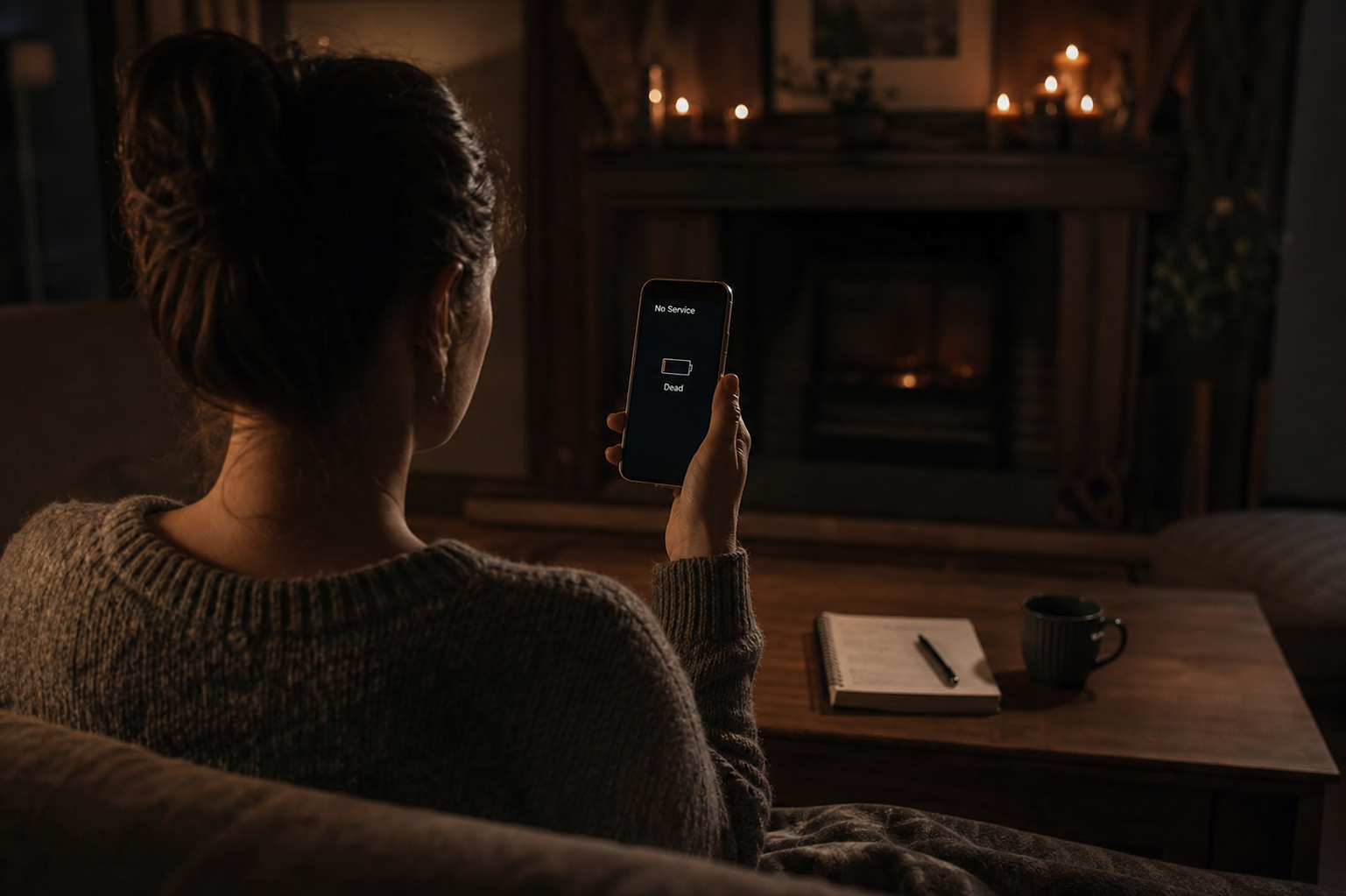
It is 9pm. Your phone just died. The power is out across your neighborhood.
You reach for your charger — and then you remember. No power means no charger. No charger means a dead phone. And a dead phone means no flashlight, no GPS, no emergency alerts, no way to call anyone, and no idea what is happening outside your door.
For most women, this scenario is where preparedness planning completely falls apart. Because almost every emergency plan we carry lives on a device that needs electricity to function.
Here is the analog backup plan every woman needs before the power goes out.
The Problem With Phone-Dependent Planning
Think about everything you rely on your phone for in an emergency:
- Emergency contact numbers — saved in your phone, not memorized
- GPS navigation — you have not used a paper map in years
- Emergency alerts — you rely on your phone to receive them
- Flashlight — your phone is your primary light source
- Communication — calling, texting, messaging all require a charged device
- Information — news, weather, status updates all require internet access
When the power goes out and your phone dies, every one of these functions disappears simultaneously. Unless you have planned for it.
⚠️ Cell Towers Fail Too
Even a charged phone is not reliable in a major emergency. Cell towers jam from call volume within minutes of a major event. During Hurricane Katrina, cell service was down for days across the affected region. Your plan cannot depend on cellular infrastructure holding up during the exact moment you need it most.
Keep Your Phone Charged — Power Solutions
Power Bank — Your First Line of Defense
A 20,000 mAh power bank charges most smartphones 4-5 times. It costs approximately $40-50. It should be in your go-bag, fully charged, at all times. Check the charge quarterly and top it off if it has dropped below 80%.
One power bank is not enough. Keep one in your go-bag and one at your nightstand. The nightstand bank is your immediate backup when the power goes out at 2am.
Solar Charging
A foldable solar panel charger — the Anker 21W is excellent — charges your power bank or phone directly from sunlight. Slow in direct use but invaluable for multi-day outages where your power bank has already been depleted.
Car Charging
Your car is a generator that most women completely forget about. A car phone charger adapter lets you charge from your car's battery. During an extended outage your car can keep your devices charged indefinitely — run the engine for 30 minutes, charge your devices, shut it off.
The Analog Backup System
Power solutions buy you time. But the real answer to phone dependency is building an analog backup system that works without any electronics at all.
Emergency Contact Card
Write the following on a physical index card and laminate it. Keep one in your go-bag and one in your wallet:
- Your out-of-state emergency contact — name and phone number memorized AND written down
- Your two nearest family members — phone numbers
- Your doctor and pharmacy phone numbers
- Your insurance company emergency line
- Local police non-emergency number
- Your home address — for if you need to tell someone where you are
Paper Maps
When is the last time you used a paper map? For most women the answer is never — or not since childhood. This is a gap that matters. GPS goes down. Cell service goes down. Paper maps do not go down.
Keep a printed map of your region in your car and in your go-bag. Circle your home, your two evacuation destinations, and the routes between them. Know how to read it before you need to.
NOAA Weather Radio
A battery-powered or hand-crank NOAA weather radio broadcasts emergency information on dedicated frequencies completely independent of the internet and cell network. It works when your phone does not, when the internet is down, and when cell towers are overloaded. This is your primary information source when every digital system fails.
What to Do Right Now
- Memorize two phone numbers. Your out-of-state contact and your nearest family member. Actually memorize them — do not rely on your contacts list.
- Write your emergency contact card. Laminate it. Put one in your wallet today.
- Order a power bank if you don't have one. 20,000 mAh minimum. Keep it charged.
- Order a NOAA weather radio. Battery or hand-crank. Test it this week.
- Print a regional map. Mark your home, two destinations, and routes.
🎯 Know Exactly Where You Stand
Take the SurvivElle Archetype Quiz — find out exactly what to tackle next.
Take the Quiz →