
Bug Out Bag vs Go-Bag
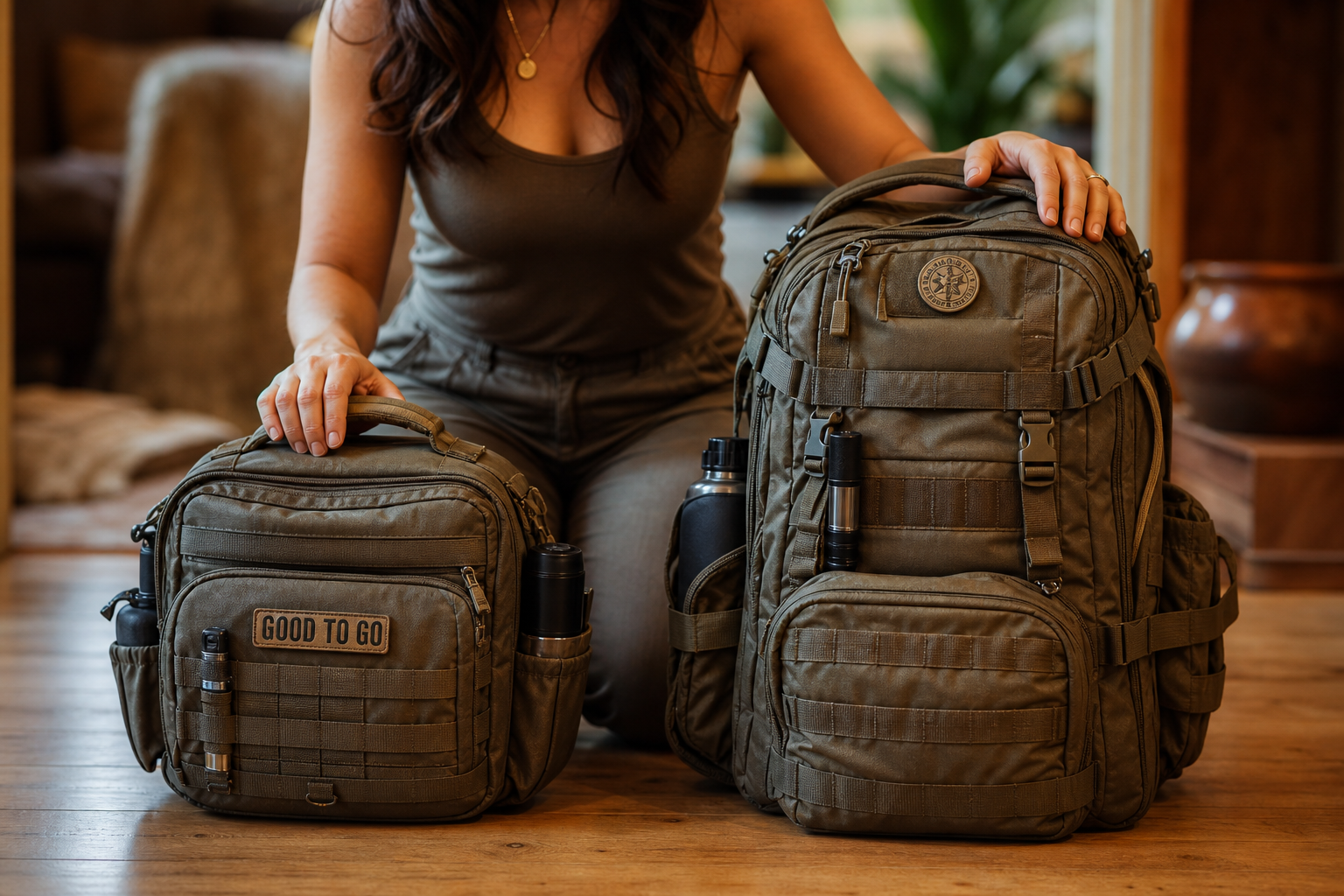
Bug Out Bag vs Go-Bag: What's the Difference and Which One Do You Actually Need?
Ask ten people what a bug out bag is and you'll get ten different answers.
Ask most women and they'll say it's the same as a go-bag — just a bag you grab when things go wrong.
That's not wrong exactly. But the difference between the two matters more than most preparedness content lets on. Building the wrong bag for the wrong scenario means either carrying 50 pounds of gear you don't need to a hotel 40 miles away — or being completely underprepared for a scenario that demands more than a weekend bag.
This post settles the question once and for all. What each bag is, what goes in it, and most importantly — which one you actually need right now based on your real life, your real situation, and your real threats.
The Honest Difference Most People Get Wrong
Here's the simple version:
The key distinction is not just duration — it is the assumption about infrastructure. A go-bag assumes gas stations, hotels, grocery stores, and cell service will be available somewhere accessible. A bug out bag assumes none of those things exist where you're going.
💡 The Most Important Thing to Understand
The vast majority of real emergencies that women face are go-bag scenarios — not bug out scenarios. Hurricane Katrina, the California wildfires, Texas Winter Storm Uri, COVID lockdowns — all of these were go-bag situations. You evacuated to somewhere with functioning infrastructure, or you sheltered in place. Building a 45-pound bug out bag before you have a solid go-bag is like buying a life raft before you have a fire extinguisher.
The Go-Bag — Built for 72 Hours
Your go-bag is the most important emergency tool you own. It should be packed, in the same location, every single day of your life. Not assembled when the alert comes. Grabbed and gone in under 2 minutes.
What Goes In It
A go-bag is not a suitcase. Everything in it earns its place. Here is the female-specific go-bag list organized by priority:
- Documents: IDs, passport, insurance cards, medication list, emergency contacts — all in a waterproof bag
- Cash: Minimum $200 in small bills — card readers fail, ATMs run out
- Medications: 30-day supply of all prescriptions in waterproof container
- Water: 1 liter minimum in the bag, Sawyer Squeeze filter for sourcing at destination
- Food: 72-hour supply of calorie-dense shelf-stable food — bars, pouches, no cooking required
- First aid: Trauma-capable kit — tourniquet, hemostatic gauze, bandages, gloves
- Communication: Battery-powered NOAA weather radio, fully charged power bank
- Light: LED headlamp with extra batteries
- Clothing: 3-day change, sturdy shoes already on your feet, rain layer
- Female-specific: Feminine hygiene — full cycle supply, any hormonal medications
- Kids and pets: If applicable — 3-day supply staged alongside your bag
The Right Bag for Women
Here is where the pink tax conversation becomes critically important. The survival and outdoor gear industry sells "women's" bags that are smaller, lighter, less functional, and more expensive than comparable men's bags. Smaller does not mean better — it means less capacity for the same essential items.
What actually matters in a go-bag:
- Load-bearing hip belt that actually transfers weight to your hips — not decorative padding
- Minimum 30-liter capacity for a solo woman — 40+ liters if carrying for a child
- Padded adjustable shoulder straps sized for a woman's torso length — not a man's
- Rain cover included or water-resistant material
- Multiple external attachment points for items you need to reach quickly
The Bug Out Bag — Built for 2 Weeks or More
A bug out bag is a completely different tool for a completely different scenario. Where a go-bag assumes you will reach functioning civilization within 72 hours, a bug out bag assumes you may not. It is built for self-sufficiency — for the scenario where infrastructure is not coming back anytime soon.
What Makes It Different
A bug out bag goes beyond survival supplies. It includes tools for sourcing food and water in the field, shelter construction, navigation without GPS, fire starting, and long-term medical self-care. It is substantially heavier, more expensive, and requires more skill to use effectively.
- Water sourcing: Full filtration system — Sawyer filter plus purification tablets plus collapsible containers for storage. You cannot rely on stored water alone for 2+ weeks.
- Food: Calorie-dense freeze-dried meals plus the means to forage and potentially hunt — fishing line, snare wire, foraging knowledge
- Shelter: Lightweight tent or tarp system, sleeping bag rated for your region's lowest temperature, sleeping pad
- Fire: Multiple fire-starting methods — lighter, waterproof matches, ferrocerium rod. Fire means warmth, water purification, cooking, and signaling
- Navigation: Topographic maps of your region, quality compass, the skill to use both
- Communication: Hand-crank emergency radio, potentially a ham radio if licensed
- Medical: Extended first aid with wound closure supplies, prescription stockpile, dental emergency kit
- Tools: Fixed blade knife, multi-tool, paracord, duct tape, work gloves
- Defense: Personal protection appropriate to your training and legal jurisdiction
The Bug Out Location — The Part Most Guides Skip
A bug out bag without a bug out location is just a heavy backpack. The bag is only as useful as the destination it is carrying you toward. Your bug out location should be:
- Pre-identified — a specific address, not "somewhere in the mountains"
- Known to at least one other trusted person
- Outside any likely evacuation or disaster zone for your area
- Accessible on foot if vehicles fail — ideally within 72 hours of walking distance
- Pre-stocked with additional supplies if possible — food, water, fuel
Which One Do YOU Actually Need Right Now?
Select your situation below and get a personalized recommendation:
Female-Specific Additions to Both Bags
Every list below applies regardless of which bag you're building. These items are absent from every mainstream bug out bag list online. They should not be absent from yours.
Go-Bag Female Additions
- Feminine hygiene — full cycle supply. Stress alters menstrual cycles. Plan for an extended or unexpected cycle, not your normal one.
- Hormonal medications. Birth control, thyroid medication, and hormone replacement therapy cannot be missed during a displacement. A 30-day supply minimum — ideally 90 days.
- Pregnancy-specific items if applicable. Prenatal vitamins, any prescribed medications, OB provider contact information written on paper.
- Personal safety. Pepper spray accessible — not buried in the bag. Personal alarm on keychain.
- Extra undergarments. More important than most gear lists acknowledge during multi-day displacement.
Bug Out Bag Female Additions
- Menstrual cups or discs. Reusable, no waste, no resupply needed. A menstrual cup is one of the most practical female-specific preparedness tools for extended scenarios.
- Urinary device for field use. GoGirl or similar — allows standing urination which is significantly safer and more private in field environments.
- Extended medication supply. 90-day supply for any critical medication. Refill prescriptions aggressively — never let them drop below 30 days.
- Self-defense training. A bug out bag scenario is the scenario where personal safety is most acute. A firearm or knife without training is more dangerous than no weapon. Invest in training before investing in weapons.
Building Both on a Budget
You do not need to spend $500 to build a functional go-bag. Here is the budget breakdown for both — prioritized by impact per dollar:
| Item | Go-Bag Cost | Bug Out Bag Cost |
|---|---|---|
| The bag itself | $40–$70 | $80–$150 |
| Water filter (Sawyer Squeeze) | $30 | $30 |
| 72-hour food supply | $25–$40 | $80–$120 |
| First aid kit (trauma capable) | $45–$65 | $65–$90 |
| NOAA weather radio | $30–$45 | $30–$45 |
| LED headlamp | $20–$35 | $35–$50 |
| Power bank | $30–$45 | $30–$45 |
| Documents waterproof bag | $12–$18 | $12–$18 |
| Shelter (sleeping bag + tarp) | Not needed | $60–$120 |
| Navigation (maps + compass) | $15 | $25–$40 |
| Female-specific items | $20–$30 | $30–$50 |
| Total range | $267–$393 | $477–$758 |
✅ Build Incrementally — Not All at Once
Nobody builds a complete go-bag in one Amazon order. Add one category per week or per paycheck. Start with documents, cash, and medications — those three items cost almost nothing and cover your most critical vulnerabilities immediately. Build from there. A partial bag is infinitely better than no bag.
Go-Bag vs Bug Out Bag — Side by Side
| Factor | 👜 Go-Bag | 🎒 Bug Out Bag |
|---|---|---|
| Duration | 72 hours — 3 days | 2 weeks to indefinite |
| Infrastructure assumption | Functioning — hotels, stores, gas available | Failed — you are fully self-sufficient |
| Weight | 15–25 lbs | 30–45 lbs |
| Cost to build | $250–$400 | $500–$800 |
| Skills required | Basic — pack, grab, drive | Advanced — navigation, fire, water sourcing, field medicine |
| Most common use scenario | Hurricane, wildfire, flood, evacuation | Grid-down, long-term displacement, SHTF |
| Destination | Hotel, shelter, family, friend | Pre-planned bug out location |
| Who needs it | Every woman — immediately | After your go-bag is complete |
| Food type | Shelf stable, no cooking required | Freeze-dried plus field foraging capability |
| Water strategy | Stored + portable filter | Full sourcing and purification system |
The 5 Most Common Mistakes Women Make
Building a bug out bag before finishing a go-bag
The most common mistake in the preparedness community. A $600 bug out bag does nothing for you during a hurricane evacuation if you have no go-bag staged at your door. Build your go-bag first. Completely. Then build upward.
Buying a "women's" bag without checking the load-bearing system
Pink straps and floral patterns do not make a bag female-friendly. A bag that cannot transfer weight to your hips will destroy your back within 5 miles. Check the hip belt construction before anything else. The Pink Tax is real — and it is dangerous.
Packing for a man's needs
Generic packing lists ignore feminine hygiene, hormonal medications, pregnancy considerations, and personal safety tools specific to women traveling alone. Your bag needs to reflect your actual life — not a list written for a 6'2" man.
Never testing the bag
A bag you have never worn, never loaded to full weight, and never walked more than 10 feet with is not a bug out bag — it is a decorative object. Wear your packed bag for a 30-minute walk. You will immediately learn what needs to change.
Letting it expire
Food expires. Medications expire. Batteries die. A go-bag that hasn't been checked in 18 months is a bag full of expired food, dead batteries, and medications that are no longer safe. Schedule a quarterly 10-minute bag audit — every single item checked.
🎯 Know Your Preparedness Level
Take the SurvivElle Archetype Quiz — 10 questions tell you exactly which bag to build first and what to prioritize for your specific situation.
Take the Quiz →🎒 Get the Free 72-Hour Survival Starter Kit
52-item checklist built specifically for women — the foundation of every great go-bag.
Get Your Free Kit →📌 Which bag are you building right now? Save this post and share it with a woman who doesn't know the difference yet.