The Pink Tax
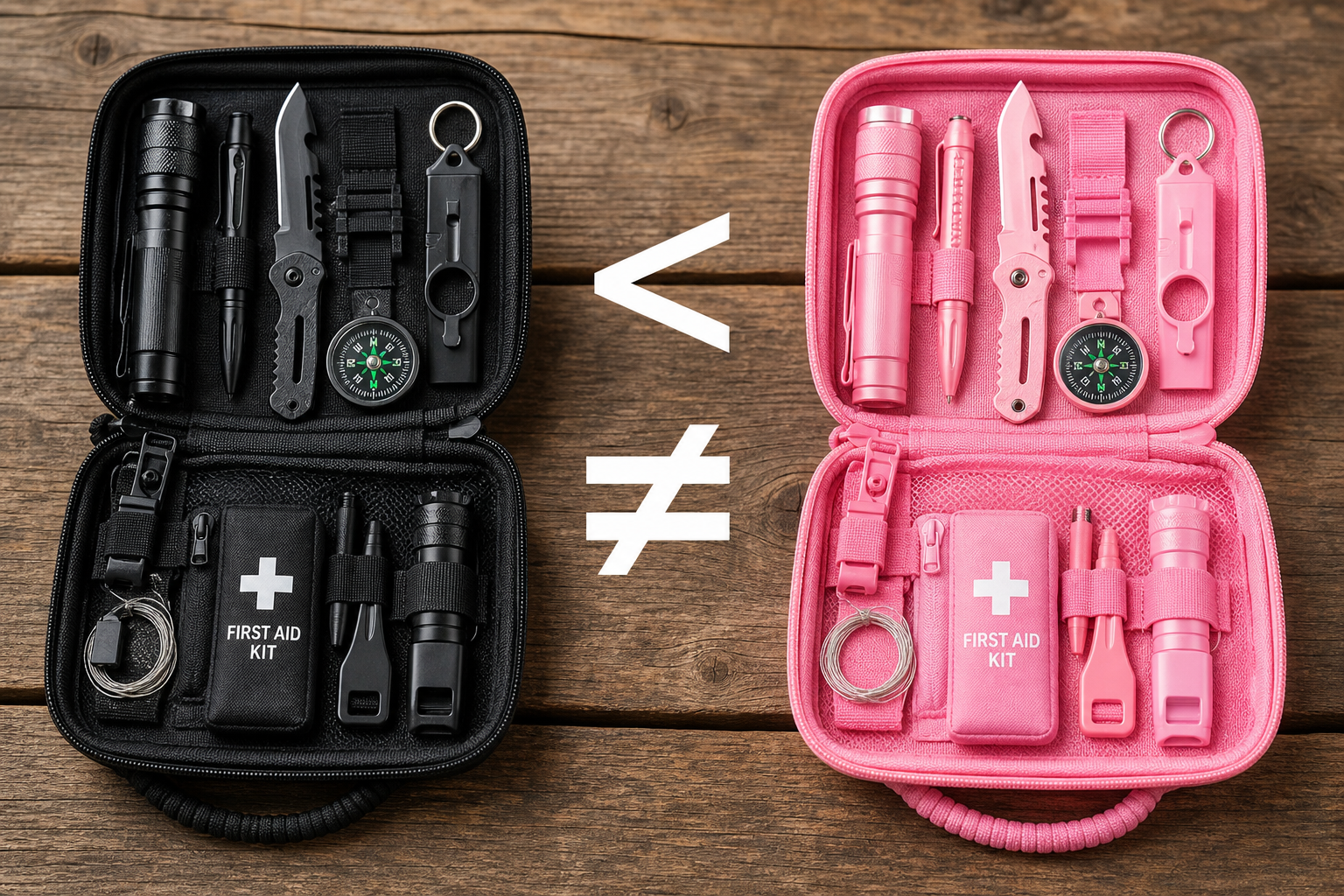
The Pink Tax: Why Your "For Her" Survival Gear Could Actually Fail You
You found the perfect water filter. Pink handle. "Designed for women."
It costs $12 more than the identical product in black. It is made of lighter-weight material. The grip is designed for smaller hands — which sounds considerate until you realize the "smaller hands" design makes it harder to use with gloves on in an actual emergency.
Welcome to the Pink Tax in survival gear. And it is costing women more than money.
What the Pink Tax Actually Is
The "Pink Tax" refers to the price premium charged on products marketed specifically to women — even when those products are functionally identical to unisex or men's versions. Studies have documented this premium across personal care products, clothing, and increasingly, outdoor and survival gear.
But in the survival gear space, the Pink Tax does something more dangerous than drain your wallet. It can give you false confidence in gear that performs worse when it actually matters.
⚠️ The Pink Tax in Survival Gear Is Not Just About Price
Lighter weight sounds like a feature. In a water filter it is a liability. Smaller size sounds convenient. In a first aid kit it means fewer supplies. "Feminine design" sounds thoughtful. In a backpack it often means a weaker load-bearing system. The aesthetics can mask functional compromises.
5 Gear Categories Where the Pink Tax Hurts Women Most
1. Backpacks and Go-Bags
Women's survival backpacks are frequently marketed with "torso-fit" designs and feminine colorways at a premium price. The problem is that many of these bags sacrifice load-bearing capacity to achieve a slimmer profile. A true women's-fit pack — one that correctly transfers weight to the hips — is a legitimate design advantage. But a pink pack with decorative stitching and a weak hip belt is not a women's pack. It is a marketing decision dressed as ergonomics.
What to look for: An actual load-bearing hip belt that transfers weight away from your shoulders. Torso length sizing that matches your actual torso — not just a "women's" label. Capacity that matches your real needs — 30+ liters for a go-bag.
2. First Aid Kits
Women's first aid kits frequently come in smaller containers with fewer items at the same or higher price than a standard kit. I have seen "her" first aid kits that contain 12 bandages and a pair of tweezers marketed as emergency preparedness tools. A real trauma-capable first aid kit — the kind that can handle a real emergency — is unisex by necessity. It contains tourniquets, hemostatic gauze, pressure bandages, and nitrile gloves. It does not come in rose gold.
What to look for: A kit with an actual tourniquet, hemostatic gauze, and Israeli pressure bandage. If it does not have these three items it is not an emergency kit — it is a medicine cabinet organizer.
3. Water Filters
The Sawyer Squeeze is the gold standard in portable water filtration. It filters 100,000 gallons, weighs 3 ounces, and costs approximately $30. "Women's" water filters exist at higher price points with smaller capacity, shorter filter life, and lighter-weight construction that does not hold up to field use. Buy the Sawyer. It is not gendered. It just works.
4. Multi-Tools
Women's multi-tools are almost universally smaller, lighter, and less capable than their unisex counterparts — at the same or higher price. A real multi-tool needs to perform real tasks: cutting, prying, turning screws. A tool too small and light to grip properly under stress is not a women's tool. It is a compromise.
5. Emergency Radios
I have seen "her" emergency radios at premium prices with reduced battery capacity and weaker reception than standard models. In an actual emergency your radio needs to pick up NOAA broadcasts when cell service fails. Battery life matters. Reception matters. The color of the casing does not.
What Women Actually Need That Most Gear Lists Ignore
Here is the genuine irony: real female-specific preparedness needs are almost never addressed in survival gear marketing — even in the "women's" products.
- Feminine hygiene supplies in your go-bag — no mainstream survival brand sells these as part of a kit
- Medications sized and packaged appropriately — hormonal medications, pregnancy-related supplements, thyroid medications
- Personal safety tools specifically for solo female travelers — pepper spray sized for a woman's hand, personal alarms that attach to keychains
- Backpacks sized for women's torso length — this is legitimate and matters, but rarely done correctly in the "women's survival" category
How to Shop Smart
The rule is simple: buy for function, not for aesthetics.
- Compare the unisex version and the "women's" version of any product side by side. Read the specs — not the marketing copy.
- Check weight, capacity, and materials. If the women's version is lighter and smaller, ask yourself: is that a feature or a compromise?
- Read reviews from people who actually used the gear in field conditions — not lifestyle bloggers who photographed it in their kitchen.
- Invest the savings from avoiding the pink premium in the female-specific items that actually matter: hygiene supplies, personal safety tools, medications.
🎯 Know Exactly Where You Stand
Take the SurvivElle Archetype Quiz — 10 questions tell you exactly what to tackle next.
Take the Quiz →